Proposed OMB Rule would give Political Commissars Veto Power on All Federal Science Grants
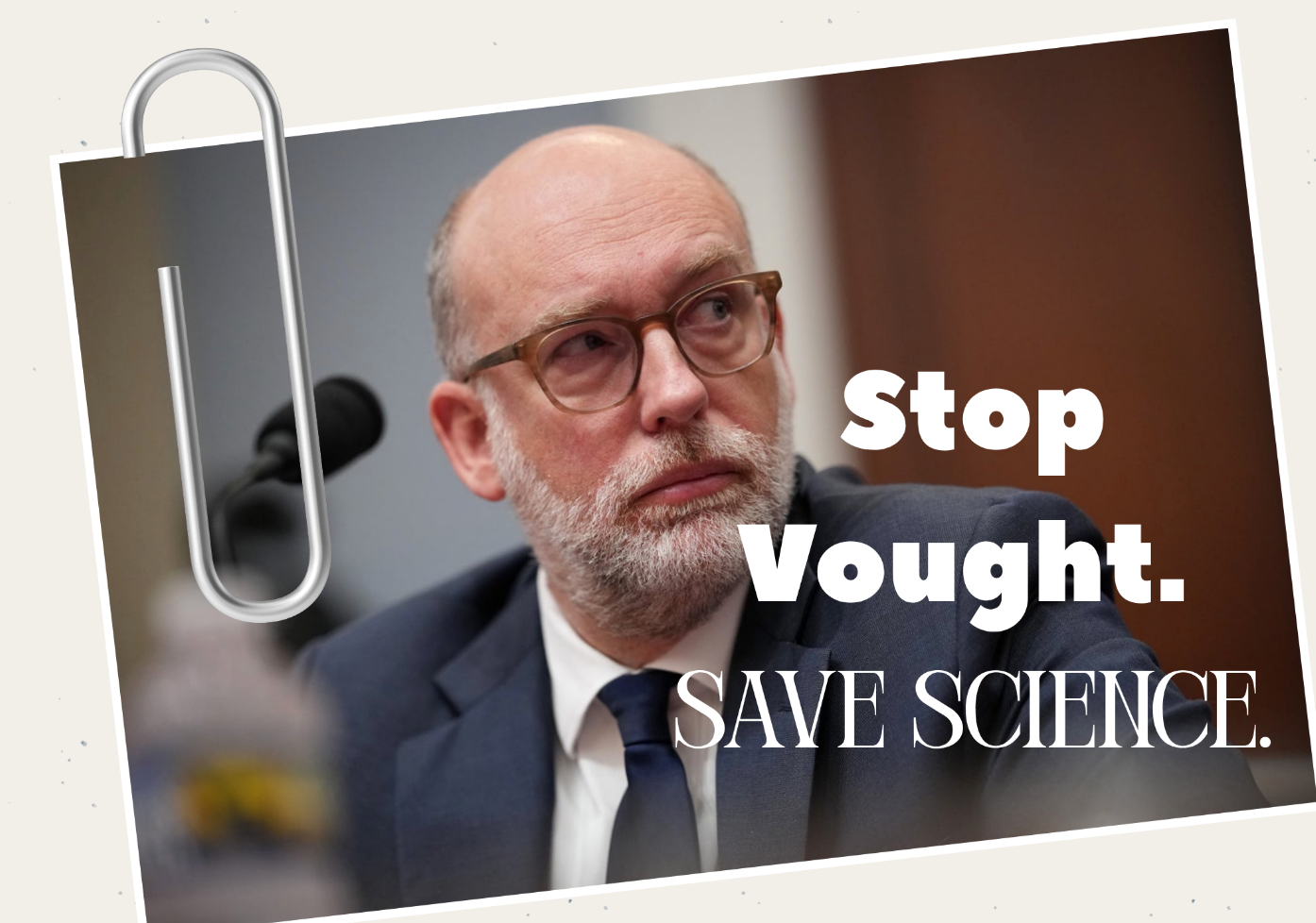
We’re raising the alarm regarding the latest in a series of assaults by the administration on the nation’s academic research. It was not announced in a boastful ceremony, but was released with no fanfare whatsoever, in the form of an agency rule with the dull designation OMB 0034-2026. What the rule does is change the framework of every federal research grant through the auspices of the Office of Management and Budget, making the research more difficult to conduct and limiting its scope. OMB is supposed to be the executive branch’s actuaries, ensuring that the budgetary items set out by Congress are accounted for at each of the agencies. Currently, OMB is headed up by Russell Vought, previously of the Heritage Foundation and the chief author of most of Project 2025.
Historically, novel findings from academic research have been problematic for authoritarians. In an authoritarian system, academics (and their institutions) must be constrained, or made to disappear. The consequence of this muzzling of the academy, though, has been to weaken such nations from within: surprising and inconvenient truths are critical to advancing technology and dealing with crises.
The OMB rule comes after several other assaults on academics. The opening attack was to state that all federal research grants could only be billed 15% in overhead costs by universities; this first gambit was successfully challenged for the most part in the courts. Thus, Vought went to one of his core ideas from his time at Heritage: universities just had too much money, and the government had to take it. And yet, it had real harms. University budgets had to be cut further, to keep a pool of money available each year to pay the Feds. Graduate student slots disappeared nationwide: MIT has had to contract the number of graduate students by 20% as compared to Autumn 2024.
Yet, it had not terrorized the academy sufficiently, in Vought’s view. Too much had been incompletely enacted, brought to light and pushed back upon. This brings us to the innocuously named poison pill: OMB 0034-2026. It is, among other things, the most unitary seizure of power by OMB over much of the rest of the executive branch’s agencies; they each have specific rules about granting that have evolved over time as best suiting their missions and pools of applicants, but this rule ends that. OMB will receive yearly reports as to who was awarded grants, and individual agencies are not to challenge the elements of this rule in their awards. The actuaries do not just audit, they command.
Other than the rule’s unprecedented assertion of OMB power over all grant processes, the centerpiece of 0034-2026 is Section 200.205. The White House itself will put its own political appointees in charge of grant review, placed in all agencies. Peer review committees of academics will still be convened, but their findings will be advisory, with the apparatchiks chosen by the President given sole authority to approve or deny grants. These commissars are also to favor institutions that the executive branch believes practice “gold standard science,” which has never been defined in its repeated usage by the administration.
The minders from the White House will not even be able to use their own judgement to reason through the merit of grants, as several other sections of the rule put specific constraints on these dogsbodies. 200.202 says that grants must align with administration policy priorities. 200.340 says that grants can be immediately terminated whenever the administration determines they are out of line with current priorities; this means that even when grants are awarded, the whim of the leader can end them. We see the usual fingerprint of authoritarianism here: do not ask questions whose answers might be inconvenient for what we want to say & do today. You cannot ably pursue multi-year academic projects in this kind of environment.
Several other parts (200.300, 200.220, 200.202e) place further binders on the academics and their overseers. There are to be no political questions, except for those that might counter policies of equity or reinforce a binary concept of gender. Grantees are to have stricter limits on foreign collaboration or travel, with the aim being for there to be none. And applicants are not to belong to any organizations that seek to push the administration from office, promote voting, or advocate for civil rights or the environment or public health. This would not only exclude most registered Democrats and whole subdepartments of social scientists, but any biomedical researcher who belongs to a physician’s professional organization.
In fact, professional membership must be approved as part of the grant (200.454). Organizations that do any issue advocacy or lobbying can be grounds for denial of the grant. Failure to declare membership is grounds for rescinding the grant. Every large academic organization, and quite a few smaller ones, lobbies lawmakers; funding is part of this mission, but so is educating elected officials on current academic understanding relevant to policies. This is a dagger straight at the heart of that public service.
Conference attendance also has to be declared at the time of the grant (200.432) and no grant monies are to be used for costs at other conferences, or conference dates not yet known at the time of the grant proposal. Coupled with a ban on journal subscription costs (200.454), publication costs (200.461), and open access database fees (200.461), this limits the public’s view of information we all paid for. It makes it easier for foreign competitors to get credit for discoveries. American universities will be less likely to get patents, if other groups can publish their findings more readily.
In point of fact, there is to be no communication with the public, if it costs the grant any money (200.421). Press interviews and public addresses as individuals might be a loophole but, with the potential to have their grant rescinded by bean-counters who themselves have to file reports with a zealous ideologue, the chilling effect is unlikely to leave many brave enough to educate the broader population. By the same token, agencies and their resident White House plants no longer need to publicly announce grant competitions at all; they can just issue awards without any transparency to the taxpayers (200.204). One need not have great imagination, only eyes and ears, to see what Trump and his corrupt cabal might do with this part of the rule.
It is not normal. Strictures like OMB 0034-2026 are a hallmark of authoritarian administrations that lack sufficient intelligence and creativity amongst their principals to provide explanations for how their ideas are still consistent with new data.
And so, we fight now, before this rule sets in and the commissars arrive to police the academy. What can people do?
Submitting reasonable and informed public comments in response to the proposed rule is critical. These comments must be addressed by the administration, and if they are not, that becomes a potential basis for groups and universities to challenge the rule in court. The comments are public evidence that the administration knew what harms the rule would cause. Comments can be done directly to the OMB or through the easy-to-use tools at Stand up For Science and the Union for Concerned Scientists.Remember that, when detailing an issue with a part of OMB-0034-2026, you should cite the section of the rule that poses that harm to academic research.
As with any other federal issues, calling Representative Clark and our two Senators does make an impact, if enough of us do it. State government officials like Governor Healey should also be contacted, to persuade them to help make up the money lost from federal cuts & attacks.
The attack on academic research has been multi-pronged, but the Resistance is already organizing to meet them on multiple fronts. The alarm is raised! Join us.